



This page collects the entire Melbet deposit and withdrawal process in one place: processing times, lower and upper limits, fee rules and fixes for the most common payout issues across e-wallets such as Skrill and Neteller, bank transfer, bank cards and crypto channels (USDT, BTC, ETH).
$2
Minimum (or equivalent)Instant
Card · wallet · crypto15 min
Fastest withdrawal24/7
Request processing| Deposit time | Instant · bank transfer 1–3 business days |
|---|---|
| Withdrawal time | Crypto 15 min–1 hour · wallet 15 min–24 hours · card 1–7 business days |
| Withdrawal min / max | $1 equivalent / $60,000 equivalent |
| Fees | Usually covered by the operator · Bitcoin always fee-free |
| Withdrawal rule | Same method as the deposit · split proportionally across multiple methods |
| Popular channels | Skrill · Neteller · bank transfer · bank card · crypto |










All financial operations in the Melbet app are gathered in the Cashier section. The side menu holds the Deposit and Withdraw links, with transaction history and payment queries just below. Thanks to this layout, once you start a Melbet deposit you never need to switch to another screen to track your balance.
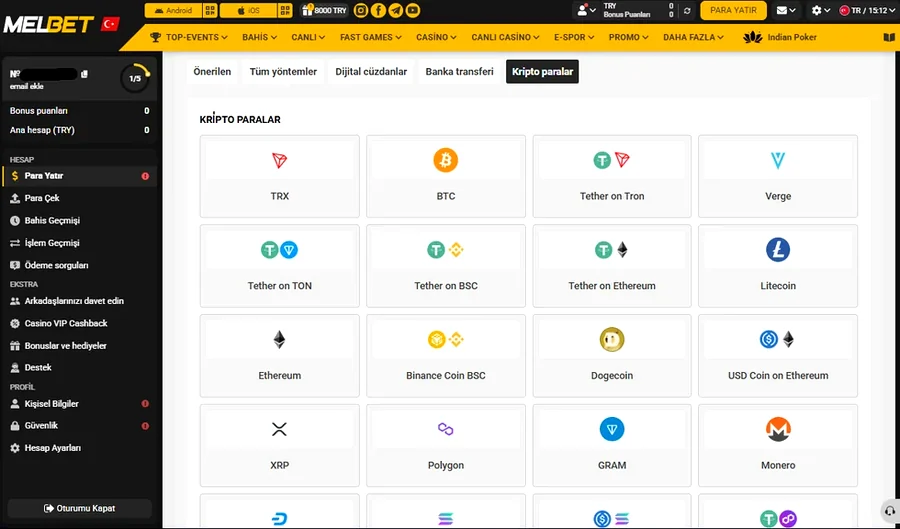
Methods are listed under five headings: Recommended, All methods, Digital wallets, Bank transfer and Cryptocurrencies. The Recommended tab is ordered by your account's past activity, so it differs from user to user; the list your friend sees may not match yours.
The cashier automatically highlights the channels most popular in your region: e-wallets, instant transfer services and bank cards. The app does this on its own — no settings need changing. International channels such as cards, Binance Pay and crypto are visible on every account.
Every request you submit lands in the transaction history with a status label. Reading this label tells you whether to wait or open a support ticket when a transfer is delayed.
| Status | Meaning | What to do |
|---|---|---|
| Pending | Request received, under review | Wait · withdrawals can still be cancelled |
| Processing | Forwarded to the payment provider | Cannot be cancelled |
| Completed | Sent to the receiving side | For crypto, track it with the TXID |
| Rejected | A mismatch was found during review | Read the reason and open a query |
On the deposit side there are four channel groups for international players: e-wallets, bank channels, bank cards and cryptocurrencies. They all feed the same balance; the differences are processing speed, the upper limit and whether that channel is open on the withdrawal side. The table below shows the difference at a glance.
| Channel | Arrival | Lower limit | Upper limit |
|---|---|---|---|
| Skrill · Neteller · Jeton e-wallets | Instant | $2 equivalent | Shown in the cashier |
| Bank card (Visa · Mastercard) | Instant | $2 equivalent | Shown in the cashier |
| Digital wallet · Binance Pay | Instant | $2 equivalent | Shown in the cashier |
| Cryptocurrency (USDT TRC-20 · BTC · ETH) | Instant | $2 equivalent | Shown in the cashier |
| Bank transfer (SEPA / SWIFT) | 1–3 business days | $2 equivalent | Shown in the cashier |
The general lower limit is $2 or its equivalent, applied at the current rate for other account currencies. Since each channel can have its own threshold, read the exact figure on the info line under the method card. Rarely, depending on the payment system or bank, a transfer can stretch from a few minutes to a few hours.
E-wallets are the most popular group among international players, because they work fast on both the deposit and the withdrawal side and are not tied to banking hours. The name on the wallet account must exactly match the name on the Melbet account; a transaction made with someone else's wallet gets stuck in review.
Deposits with Visa and Mastercard cards settle instantly. The card must be enabled for 3D Secure verification; if it is disabled, the bank rejects the transaction. Some banks block gaming-related payments under their own policies, so if a card is not working, the problem is not always in the app.
An approved card transaction reaches the balance within seconds; the most practical route for live betting.
Card withdrawals take 1–7 business days and may not be open in every region.
If your bank issues virtual cards, you can deposit without ever sharing your real card number.
On the banking side, SEPA and SWIFT transfers along with instant transfer services are listed as separate cards in the cashier. This group suits high-value transactions; on the other hand it depends on the banking calendar, so requests opened at the weekend move on the first business day.

The international wallet side includes Payurus, MoneyGO, ecoPayz, BybitPay and Binance Pay. The advantage of this group is that you can transact without sharing your card details directly; they are also fast on the withdrawal side.

Crypto is the busiest group in the cashier: more than forty assets, each with its own network options. The headliners are USDT (TRC-20), Bitcoin (BTC) and Ethereum (ETH) — deposits are credited instantly, 24/7, and withdrawals typically clear in 10–30 minutes. Bitcoin transactions are always fee-free; for other assets only the chain's own network fee applies.
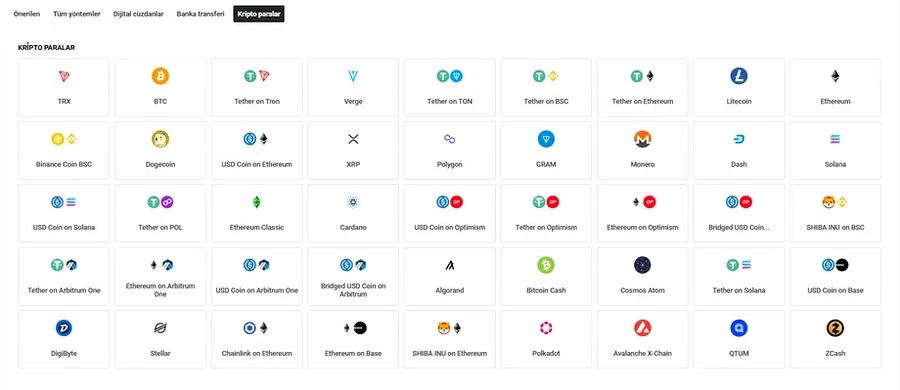
The deposit flow is the same for every method, and once you are used to it, it takes less than a minute. The steps below walk a first-time user through what appears on screen, in order.
Open the app and sign in. If biometric login is on, you land straight on the home screen without a password prompt.
Use the Deposit shortcut in the top bar or the same link in the side menu.
Switch to one of the tabs and select the channel. The lower and upper limits for that method are written under the card.
Cards ask for a 3D Secure code, wallets for provider approval, and crypto shows a generated address to send to.
On instant channels the amount appears immediately. If it is delayed, track the status in your transaction history.
When using a new channel for the first time, testing with a small amount is the most practical approach; that way you confirm the flow works before a large transfer. If you plan to join a promotion, read the terms before depositing, because some promotions exclude certain channels. The details are compiled on the Melbet bonuses page.
A deposit not showing in your balance rarely means the money is lost; the transaction is most likely waiting at some stage. First be patient for a few minutes and read the status in your transaction history, then apply whichever of the cases below fits.
| Situation | Likely cause | Fix |
|---|---|---|
| Bank charged the amount, balance unchanged | Delay between authorisation and settlement | Wait a few minutes; if it persists, open a ticket with the receipt |
| Bank transfer not matched | Reference code missing from the payment description | Send the receipt and code to the support team |
| Crypto transfer not showing | Network confirmations not yet complete | Check the confirmation count in a block explorer using the TXID |
| Crypto never arrived | The wrong network may have been selected | Open a support ticket immediately with the TXID |
| Amount not credited | The transfer fell below the lower limit | Check the channel's threshold and open a query |
| Card transaction rejected | The bank may have blocked the payment | Do not retry until the refund appears; use another channel |
When opening a support ticket, include the date, amount, method and, if available, the TXID or receipt number. These four details are enough to match the transaction with the provider-side record, so the exchange does not drag on unnecessarily.
The withdrawal side is one step longer than deposits: the request first passes internal review, then goes to the payment provider. The times below are the total of these two stages, and requests are processed around the clock.
| Channel | Approval time | Lower limit | Upper limit |
|---|---|---|---|
| Cryptocurrency (USDT TRC-20 · BTC · ETH) | 15 min – 1 hour | $1 equivalent | $60,000 equivalent |
| Digital wallet | 15 min – 24 hours | $1 equivalent | $60,000 equivalent |
| Payment systems | 15 min – 24 hours | $1 equivalent | $60,000 equivalent |
| Mobile payment | Instant – 24 hours | $1 equivalent | $60,000 equivalent |
| Bank card | 1–7 business days | $1 equivalent | $60,000 equivalent |
| Bank transfer (SEPA / SWIFT) | 2–7 business days | $1 equivalent | $60,000 equivalent |
The general lower limit is $1 and the upper limit is $60,000 or its equivalent; other account currencies are converted at the current rate. Still, the channel you choose may have a higher threshold of its own, so the lowest amount does not apply to every method. The fastest route is crypto; cards and bank transfers move in business days, making them the slowest options.
Withdrawals go through the method you deposited with. This rule exists to prevent money laundering, but in practice it binds you; the smartest move is therefore to deposit via the channel you also want your winnings sent to.
If you deposited with more than one method, your withdrawal request is split across those methods in proportion to your deposits. In other words, if you funded the account from three separate channels, do not expect the whole amount from one channel; the system distributes it automatically.
A request still marked "pending" can be cancelled, and the amount returns to your balance. Once the status changes to "processing", the request has passed to the provider; from that point it cannot be reversed.
A separate wallet address is generated per network for each account, and that address belongs to your account alone. Because the same asset is offered on multiple networks, checking the network before sending is critical; a transfer sent to a mismatched network will not be matched.
The values below are the networks' own technical characteristics. The operator-side crypto withdrawal time is 15 minutes to 1 hour.
| Network | Typical confirmation | Approx. network fee | Best use |
|---|---|---|---|
| Solana | 1–3 min | Under $1 | Small, frequent transfers |
| Tron (TRC-20) | 5–15 min | Around $1 | Everyday transactions (USDT) |
| BNB Smart Chain (BEP20) | 5–15 min | Under $1 | Exchange wallet transfers |
| Arbitrum · Optimism · Base | 5–15 min | Around $1 | Ethereum alternative |
| Ethereum (ERC20) | 15–30 min | High at busy times | Large amounts (ETH, USDT) |
| Bitcoin mainnet | 20–40 min | Depends on congestion | Fee-free transactions |
The practical takeaway: sending small amounts over the Ethereum mainnet makes no sense because of the fees. The same transfer completes far more cheaply over Tron or Solana. On the Bitcoin side, the operator charges no fee, so you only pay the chain's own cost.
After copying an address, visually compare the first and last four characters. Clipboard-hijacking malware strikes at exactly this point. Sending a symbolic test amount before a large transfer also greatly reduces the risk of loss.
Any exchange difference that appears during a deposit relates directly to your account currency. The currency is chosen when the account is opened, and changing it later requires a support ticket. If you use a USD account, no extra conversion occurs when you transact with USD-denominated wallets or USDT. By contrast, when you send from a wallet in another currency, the amount is converted at the rate applicable at the time of the transaction.
The way to avoid double conversion is to match the sending instrument's currency with your account currency. Your bank may also apply its own exchange margin; that cost is not visible in the cashier and must be checked against the total on the sending side.
In the responsible gaming section of your account settings you can define a daily, weekly or monthly deposit cap. The limit takes effect immediately; increase requests are subject to a waiting period, because instant removal would defeat the tool's purpose. Defining a budget upfront is far more effective than trying to rein it in later.
Withdrawal requests rarely get stuck, and the cause usually falls under a handful of headings. The table below summarises the most common situations and the step to take for each.
| Problem | Cause | Fix |
|---|---|---|
| Request stuck on pending | Verification not completed | Fill in your account details in full |
| Request rejected | Name on the payment method does not match the account | Only use instruments registered in your own name |
| Bonus balance reset | A promotion was still in wagering | Check the wagering status in the panel |
| Cannot pick another channel | The same-channel rule is in effect | Use the channel you deposited with |
| Crypto withdrawal not showing | The destination wallet is on a different network | Verify the address and network together |
| Amount arrived in parts | Deposits were made with multiple methods | Normal under the proportional split rule |
| Method missing from the list | Provider temporarily under maintenance | Try again a few hours later |
If your problem falls outside these headings, writing to live support with your request number is the fastest route. Because the support team can see the transaction record directly, queries are usually resolved the same day.
Financial transactions are protected by independent layers. Knowing these layers keeps you from panicking when an unexpected verification request appears.
The connection is encrypted with a current TLS version, meaning nobody intercepting it can read the data. Card details are processed by certified payment providers, not on the operator's own servers. The practical consequence: your card number is never stored in the gaming system.
Before a withdrawal you may be asked to verify personal details such as first name, last name and date of birth. Extra verification steps can come up on the first withdrawal, and the information requested depends on your account's status. Once the process is completed, subsequent requests move much faster.
Even if your password is stolen, nobody can log in without the second step.
If offered in the security settings, enable it; anyone accessing the account cannot move funds without the PIN.
You get an alert on every new-device login; if you see one you do not recognise, change your password.
Never reuse a password from another site; leaked credential lists get tried.
The most common threat is accounts posing as the support team. Real support never asks for your password, your full card number or a verification code. Messages like "let us double your balance" and payment requests via unofficial links must be refused in every case.
The right deposit channel depends on the instrument you already hold and on your priority. The comparison below summarises the common usage profiles.
| Your priority | Recommended channel | Why |
|---|---|---|
| Fastest withdrawal | Crypto (Solana · TRC-20) | Settles within 15 minutes – 1 hour |
| Ignoring banking hours | Skrill · Neteller · digital wallet | Works weekends included |
| High amounts | Bank transfer (SEPA / SWIFT) | The common choice for large transactions |
| Paying no fees | Bitcoin | Always fee-free on the operator side |
| The most familiar method | Bank card | Instant deposit; withdrawal 1–7 business days |
If you already have a Skrill or Neteller account, start there: deposits and withdrawals run through the same channel, and the same-channel rule will never trip you up later. If you do not use those wallets and you are at home with crypto, USDT on TRC-20 is the most balanced option for everyday amounts. If a bank card is all you have, deposit by card — but factor in from the start that withdrawals move in business days.
The general lower limit is $2 or its equivalent, applied at the current rate for other account currencies. Each channel may have its own threshold; the exact value is shown under the method card in the cashier.
Bank cards, e-wallets such as Skrill and Neteller, digital wallets and cryptocurrency deposits (USDT TRC-20, BTC, ETH) are processed instantly. Bank transfers take 1–3 business days.
Payment system fees are usually covered by the operator; in rare cases the cost may be passed on to the user. Bitcoin transactions are always fee-free. Your bank or wallet provider may apply its own charge separately.
Yes, e-wallets are listed in the cashier and work fast on both the deposit and the withdrawal side. The name on the wallet must match the name on the account.
Crypto withdrawals take 15 minutes to 1 hour, digital wallets and payment systems 15 minutes to 24 hours, mobile payments instant to 24 hours, bank cards 1–7 business days, and bank transfers 2–7 business days.
The general lower limit is $1 or its equivalent, and the upper limit is $60,000 or its equivalent. The channel you choose may have a higher threshold of its own.
No. Withdrawals go through the method you deposited with. If you used more than one method, the amount is split across them in proportion to your deposits.
The most common causes are: verification not completed, the name on the payment method not matching the account, a bonus still in wagering, or a different channel being selected. If the problem persists, contact live support with your request number.
First wait a few minutes and check the status in your transaction history. For crypto transfers, check the number of network confirmations using the TXID. If the problem persists, contact support with the date, amount, method and receipt or TXID.
The network shown in the cashier must match the network in your wallet. For everyday amounts, Tron (TRC-20) and Solana are the most economical options; if a different network is selected, the transfer will not be matched.
If the status is "pending", it can be cancelled and the amount returns to your balance. If the status has changed to "processing", the request has passed to the payment provider and cannot be reversed.
Yes. In the responsible gaming section of your account settings you can define a daily, weekly or monthly cap. The limit takes effect immediately; increase requests are subject to a waiting period.
Card and e-wallet deposits land instantly; on the crypto side, Solana and TRC-20 are the lowest-fee networks.
Deposit to My Account →
Betting and casino games can be addictive. Before depositing, set a daily or monthly limit in your account settings and only play with money you can afford to lose. For support, reach out to BeGambleAware, GamCare or Gamblers Anonymous — free, confidential help is available. No play under 18.